


Thanksgiving weekend is the one time of year when retail prices drop far enough, across enough stores, that sourcing at retail can actually work. It is also the weekend when resellers buy the most inventory they later regret. A door-buster is priced to get shoppers through the door, not to leave room for your margin, and plenty of "deals" are the same price everywhere, all season long.
This year Thanksgiving falls on Thursday, November 26, 2026, which puts Black Friday on November 27, Small Business Saturday on November 28 and Cyber Monday on November 30. Here is how to decide, quickly and in the aisle, which door-busters are worth flipping and which ones to leave on the shelf.
The One Test Every Door-Buster Has to Pass
Before anything goes in your cart, it has to clear a simple test: what will it sell for after the sale is over, minus fees and shipping, compared with what you are paying today? Three numbers decide that:
- Sold price, not asking price. Look up recent sold listings for the exact item, size and colorway on eBay, Poshmark or the marketplace you plan to use. Active listings tell you what sellers hope for. Sold listings tell you what buyers paid. Our guide to using sold data and comps walks through how to read them.
- Your real costs. Marketplace fees, the shipping label if you pay it, packaging, and sales tax on your purchase.
- Your floor. The minimum profit that makes an item worth your time and cash. Pick a number before you leave the house, whether it is a dollar amount, a multiple of cost, or both, and do not renegotiate it with yourself in the checkout line.
If an item cannot clear your floor using a realistic sold price, it is not a deal for you, no matter how big the red sticker is.
Door-Busters Worth Flipping
There is no universal list of winners, because it depends on your market, your sizes and your marketplaces. But the items that tend to work share a few traits: the discount is genuinely unusual, supply is limited, and demand lasts beyond the weekend.
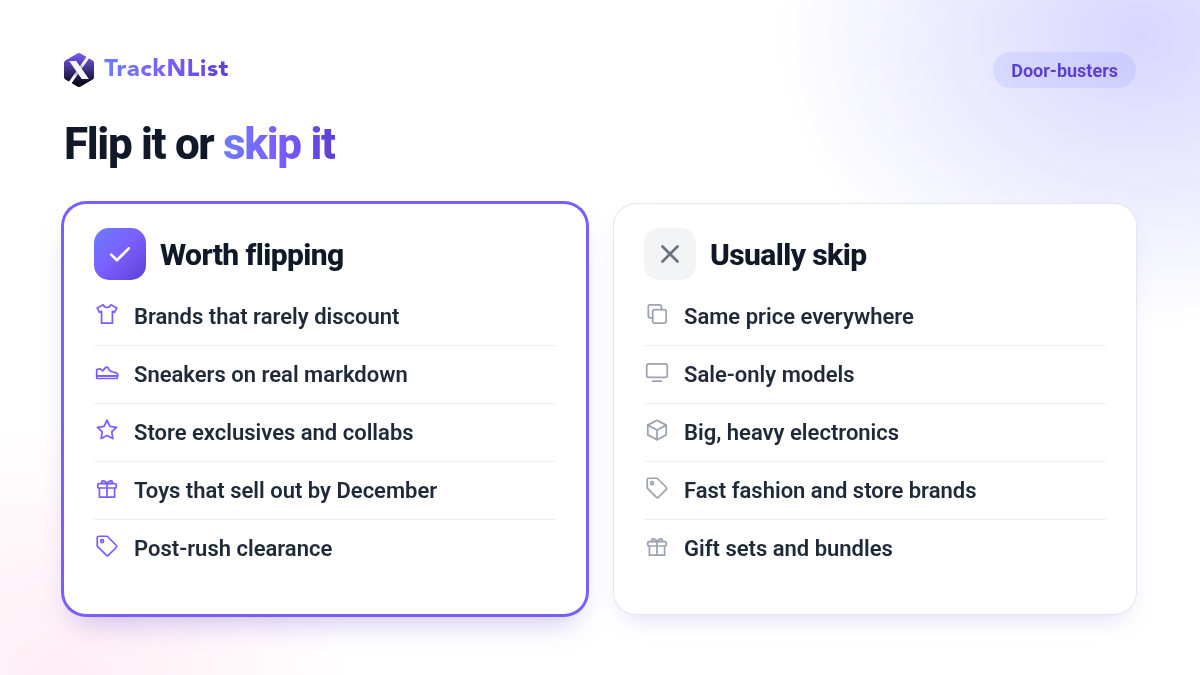
- Name-brand apparel and outerwear from brands that rarely discount. When a brand that is almost never on sale shows up at a deep markdown, the gap between your cost and normal resale prices can be real. Stick to core styles and in-demand sizes.
- Sneakers on genuine markdown. General releases and older colorways sometimes land in outlet and department store sales. Check comps by size, because one size can sell for well over retail while another sits for months.
- Limited or store-exclusive items. Exclusive colorways, collabs and limited bundles that sell out in-store and are not restocked online often carry demand into December.
- Toys and collectibles likely to sell out before the holidays. Items that disappear from shelves in early December can sell well right up to the gift deadline. The window closes fast after Christmas, so price to move.
- Clearance that shows up after the rush. Some of the best buys appear on Saturday, Sunday and the following week, when stores mark down leftover stock and the crowds have gone home.
Door-Busters to Skip
These are the categories that look like easy money and usually are not:
- Deals that are the same price everywhere. If every big retailer is matching the same price, every buyer can get it too. You are competing with the store itself, and resale prices tend to drop to the deal price.
- Special models made for the sale. Some retailers sell versions of TVs, laptops and appliances built specifically for Black Friday, with model numbers that look close to the regular version. Buyers who research them will not pay regular-model prices, and comps are hard to find.
- Big, heavy electronics. Margins are thin, shipping is expensive, damage claims are painful, and buyers can often return the same item to the store they bought it from.
- Fast fashion and store brands. Low original prices leave almost nothing after marketplace fees and shipping, even at a steep discount.
- Holiday gift sets and bundles. They sell well in December and then fall off a cliff. Anything unsold on December 26 becomes dead stock.
When in doubt, run the item through your own buy box rules for what not to buy. Most regret purchases break at least one of them.
Run the Math Before You Buy: a Worked Example
Say a fleece jacket from a brand that rarely discounts is marked down to $45, and recent sold listings for that style and size cluster around $90. Here is what the same sale looks like on eBay and Poshmark, using each platform's published fees.
On eBay, the final value fee in most categories is 13.6% of the total amount of the sale, which includes shipping and sales tax, plus $0.40 per order over $10 (eBay selling fees). If you offer free shipping at $90 and the buyer pays 7% sales tax, the total is $96.30. The fee is about $13.10 plus $0.40, or $13.50. Assume a $9 label and a listing within your free monthly allowance, and you keep about $67.50, a profit of about $22.50.
On Poshmark, sales of $15 or more carry a 20% fee, and the buyer pays the shipping (Poshmark seller guide). Sell at $90 and the fee is $18, so you keep $72, a profit of $27. But Poshmark buyers make offers. Accept $80 and you keep $64, a profit of $19.
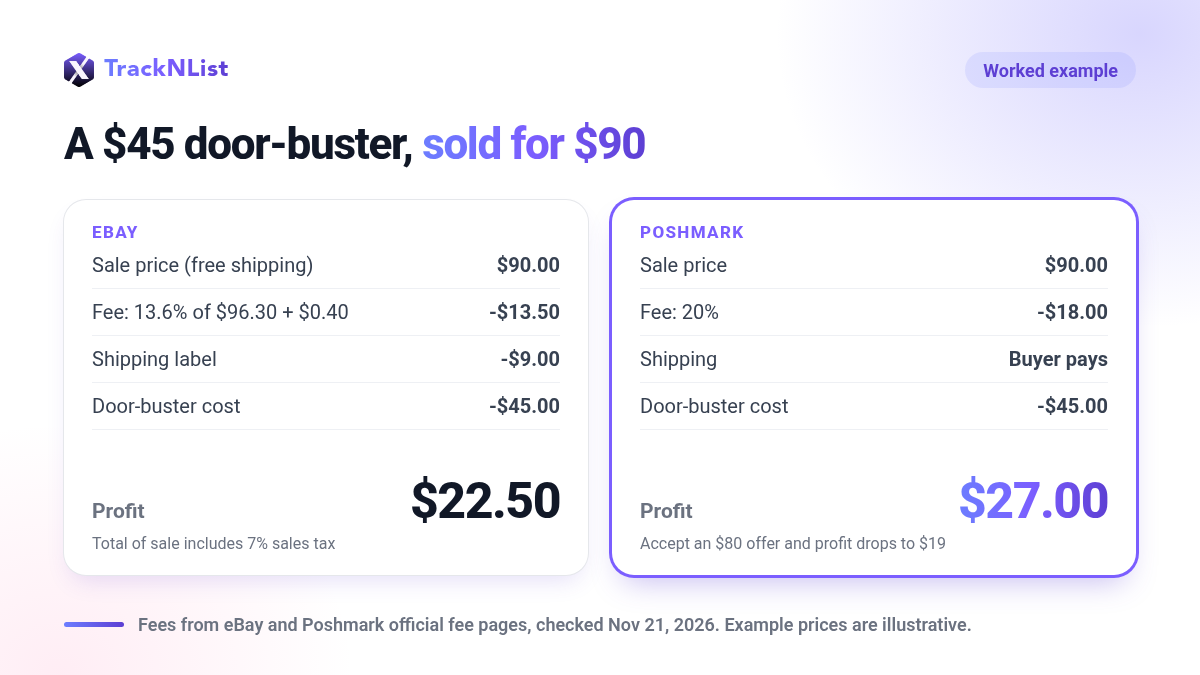
The lesson is not that one platform always wins. It is that a $45-to-$90 flip is a $19 to $27 profit, not a $45 one, and that gap gets smaller fast if the jacket sells for $75 instead of $90. Our full breakdown of eBay fees in 2026 covers category rates and the $150 sneaker rule, and the TrackNList profit calculator runs the same math for each marketplace in seconds.
Protect Your Margin at Checkout
Even a good buy can go wrong between the shelf and the listing. A few habits keep your flips sellable:
- Inspect before you pay. Check sizes, tags, missing pieces and box condition. Buyers paying near-retail prices for new items expect new condition, and a crushed box or missing tag can turn a profit into a return.
- Respect purchase limits. Stores often cap door-buster quantities, and trying to get around limits can get orders cancelled. Spread your budget across several items instead of going deep on one.
- Keep proof of purchase. Receipts help with returns, with authenticity questions from buyers, and with your bookkeeping at tax time.
- Track your total spend as you go. It is easy to blow a weekend budget one "good deal" at a time. Log each purchase with its cost and target price the moment you buy it, so you always know how much cash is tied up in unlisted stock.
Buying three units of something you have already proven sells is usually safer than buying one each of ten untested items. Depth on a proven winner beats a cart full of maybes.
Your Thanksgiving Weekend Game Plan
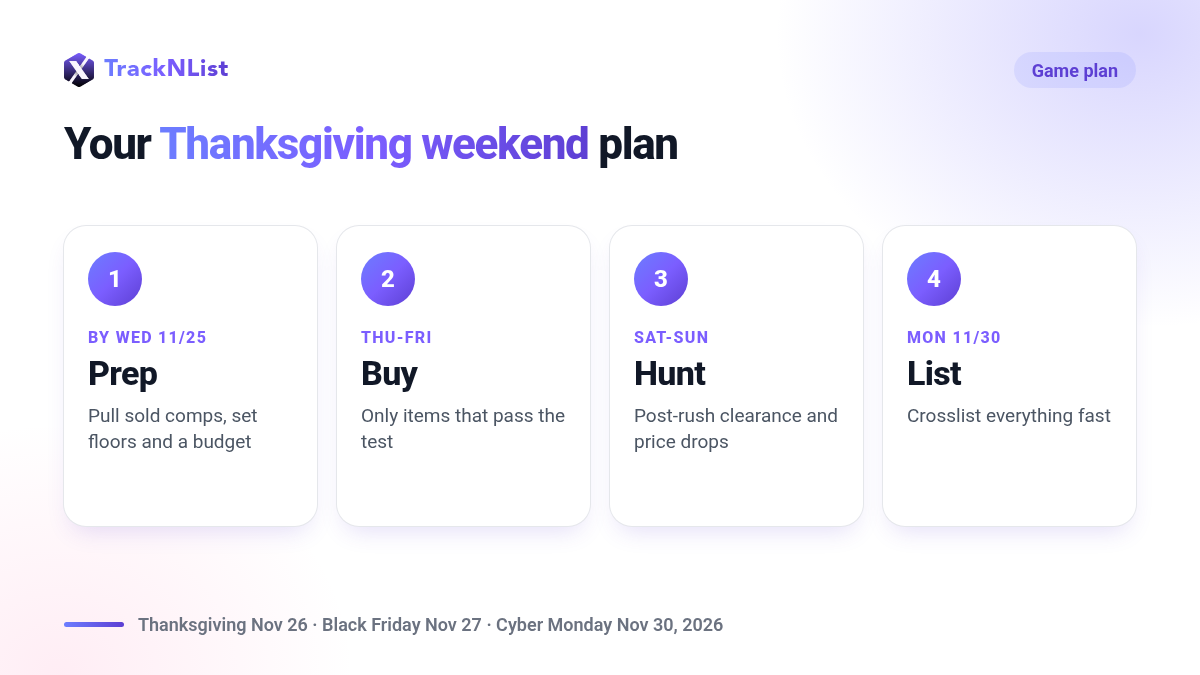
- Before Thursday: pull sold comps for the items you expect to see, write your floor next to each, and set a total budget for the weekend.
- Thursday and Friday: buy only items on your list or ones that clearly pass the test in the aisle. Keep every receipt, and photograph tags and boxes before you open anything.
- Saturday and Sunday: check for post-rush clearance and price drops on items you already bought. Many retailers adjust or extend return windows over the holidays, so check the policy on your receipt in case an item does not pan out.
- Monday onward: list everything fast. Holiday buyers shop early, and every day an item sits is a day closer to the gift-shipping deadlines carriers publish each December.
Do Not Let Inventory Pile Up Unlisted
The fastest way to lose money on Black Friday inventory is to let it sit in bags until January. Plan a listing session for the weekend itself, and list each item on more than one marketplace so it reaches more holiday buyers. Our Black Friday crosslisting checklist covers how to prep every marketplace in one night.
Crosslisting does raise one risk: selling the same item twice. TrackNList keeps your inventory in one place, crosslists to 10+ marketplaces, and delists everywhere else the moment an item sells, so you can list your Thanksgiving haul everywhere without overselling. It also tracks what you paid against what you sold for, so you know which door-busters were actually worth it.
Start free and get every door-buster flip listed, tracked and synced across your marketplaces before the holiday rush peaks.


