


eBay fees look simple until you try to work out what you actually kept on a sale. There is a percentage, a per-order charge, a different rate for some categories, a special rule for sneakers, optional upgrades, ads, and penalty fees that only show up if your account slips. Miss one and your pricing is off on every listing.
This guide walks through every fee a typical US eBay seller pays in 2026, with worked examples you can check yourself. All rates come from eBay's own Selling fees page, which we checked on November 20, 2026. eBay changes fees from time to time, so treat that page as the final word before you price anything big. If you want the cross-platform view first, our complete breakdown of marketplace fees compares eBay with the other major apps.
The Two Fees Every eBay Seller Pays
For most listings on eBay.com, you deal with two main charges:
- Insertion fee: charged when you create a listing. You get up to 250 zero insertion fee listings every month (more if you have an eBay Store). After that, it is $0.35 per listing in most categories.
- Final value fee: charged when the item sells. In most categories it is 13.6% of the total amount of the sale (up to $7,500 per item), plus a per-order fee of $0.30 for orders of $10 or less, or $0.40 for orders over $10.
eBay also notes that you do not pay a separate third-party payment processing fee. Payment processing is rolled into the final value fee, which is why the percentage is higher than it was years ago when PayPal charged separately.

What Counts as the "Total Amount of the Sale"
This is the part most sellers get wrong. eBay does not charge the final value fee on your item price alone. The total amount of the sale includes:
- The item price
- Any shipping the buyer pays (with a few exceptions)
- Handling charges
- Sales tax
- Any other applicable fees
So if you charge $10 for shipping, you pay the final value fee on that $10 too. And because sales tax is included, the same item can cost slightly more in fees when it sells to a buyer in a higher-tax state. There are some exceptions on shipping: for example, if you offer both a cheap domestic option and pricier 1-day or international shipping, eBay calculates the fee on the cheapest domestic option you offer.
eBay defines an order as any number of items bought by the same buyer at checkout with the same shipping method, so the per-order fee is charged once per order, not once per item.
Final Value Fees by Category
13.6% covers most categories, but several are different. These are the ones resellers run into most often, straight from eBay's basic fee table:
- Most categories (clothing, electronics, home and more): 13.6% on the total up to $7,500 per item, 2.35% on the portion over $7,500.
- Athletic sneakers (Men's and Women's Athletic Shoes): 8% with no per-order fee if the total amount of the sale is $150 or more. 13.6% if it is under $150.
- Women's Bags & Handbags: 15% if the total is $2,000 or less, 9% if it is over $2,000.
- Jewelry & Watches (except Watches, Parts & Accessories): 15% if the total is $5,000 or less, 9% if it is over $5,000.
- Watches, Parts & Accessories: 15% on the first $1,000, 6.5% on the portion from $1,000 to $7,500, and 3% above that.
- Books, Movies & TV, and Music (except vinyl): 15.3% up to $7,500.
- Trading cards, comics and select collectibles: 13.25% up to $7,500.
- Guitars & Basses: 6.7% up to $7,500, with free insertion.
eBay Store subscribers, vehicle sellers and eBay Live sellers have their own fee schedules, so check those pages if any of them apply to you.
The $150 Sneaker Rule (and Why It Matters)
If you sell sneakers, the athletic shoe rule is the most important line on the whole fee page. Once the total amount of the sale hits $150, the rate drops from 13.6% plus the per-order fee to a flat 8%, and listings with a starting price of $150 or more get free insertion. Here is what that looks like on two pairs, both with free shipping and 6% sales tax:
- Pair sold for $140: total of the sale is $148.40, under the threshold. Fee is 13.6% of $148.40 plus $0.40, which comes to about $20.58.
- Pair sold for $220: total of the sale is $233.20, over the threshold. Fee is 8% of $233.20 with no per-order fee, which comes to about $18.66.
The cheaper pair costs you more in fees. If you have a pair sitting just under the line, it is worth running the numbers before you drop the price. Many sneaker sales over the threshold also go through eBay's Authenticity Guarantee. Our guide to passing Authenticity Guarantee the first time covers that process, and eBay notes that when you use the free Authenticity Guarantee shipping label, no final value fee is charged on the shipping.

A Full Worked Example
Say you sell a hoodie for $40, the buyer pays $8 for shipping, and their sales tax comes to $3.36. You have already used your 250 free listings this month, and your account is in good standing.
- Total amount of the sale: $40 + $8 + $3.36 = $51.36
- Final value fee: 13.6% of $51.36 is about $6.98, plus $0.40 per order = about $7.38
- Insertion fee: $0.35
- Total eBay fees: about $7.73
That works out to roughly 19% of your $40 item price, before you pay for the shipping label itself. This is exactly why pricing from the item price alone can mislead you. Plug your own numbers into the TrackNList profit calculator to see what you keep on eBay compared with other marketplaces.
Optional Upgrades and Ads
These are fees you choose to pay. For fixed price, Good 'Til Cancelled listings, eBay lists these upgrade fees:
- Bold: $4.00
- Subtitle: $2.00 for items up to $150, $6.00 over $150
- Gallery Plus: $1.00 (free in Art, Antiques, Collectibles, and Pottery & Glass)
- International site visibility: $0.50
- Listing in a second category: a second insertion fee, upgrade fees apply again, and the higher of the two final value fees is charged if it sells
Auction-style listings have their own upgrade prices, including a reserve price fee of $5.00 or 7.5% of the reserve, whichever is greater (capped at $250), charged whether or not the item sells. If you are deciding between formats, our post on auction, Buy It Now or Best Offer goes deeper.
One important detail: Good 'Til Cancelled listings renew once a month, and eBay charges the insertion fee and any upgrade fees each time a listing renews. A $4 Bold upgrade on a slow mover is charged again every month it sits.
Promoted Listings are separate. eBay's advertising programs come with their own terms and costs, and those charges show up on your monthly statement on top of your selling fees. Always count your ad rate when you work out your profit on a promoted sale.
Fees You Only Pay When Something Goes Wrong
These are the ones to avoid completely:
- Below Standard seller level: if your account is rated Below Standard at the evaluation on the 20th of the month, you pay an additional 6% in final value fees on the next month's sales. After four or more consecutive months, it rises to 7%.
- Very High "item not as described" returns: a Very High rate in a category adds 5% to final value fees in that category the following month, rising to 6% after four or more consecutive months.
- Dispute fee: $20 for each dispute, such as a chargeback, where you are found responsible.
- International fee: 1.65% of the total amount of the sale when the buyer is outside the US, unless you ship through eBay International Shipping, in which case US sellers are not charged this fee.
- Selling outside eBay: if you share or ask for contact details to complete a sale off eBay, you can be charged a final value fee even if the item never sells on eBay.
Overselling is one of the fastest ways to drag down your seller level, because every cancelled order counts against you. If you crosslist, keeping inventory synced across marketplaces protects your eBay rate as much as your reputation.
How to Keep More of Every eBay Sale
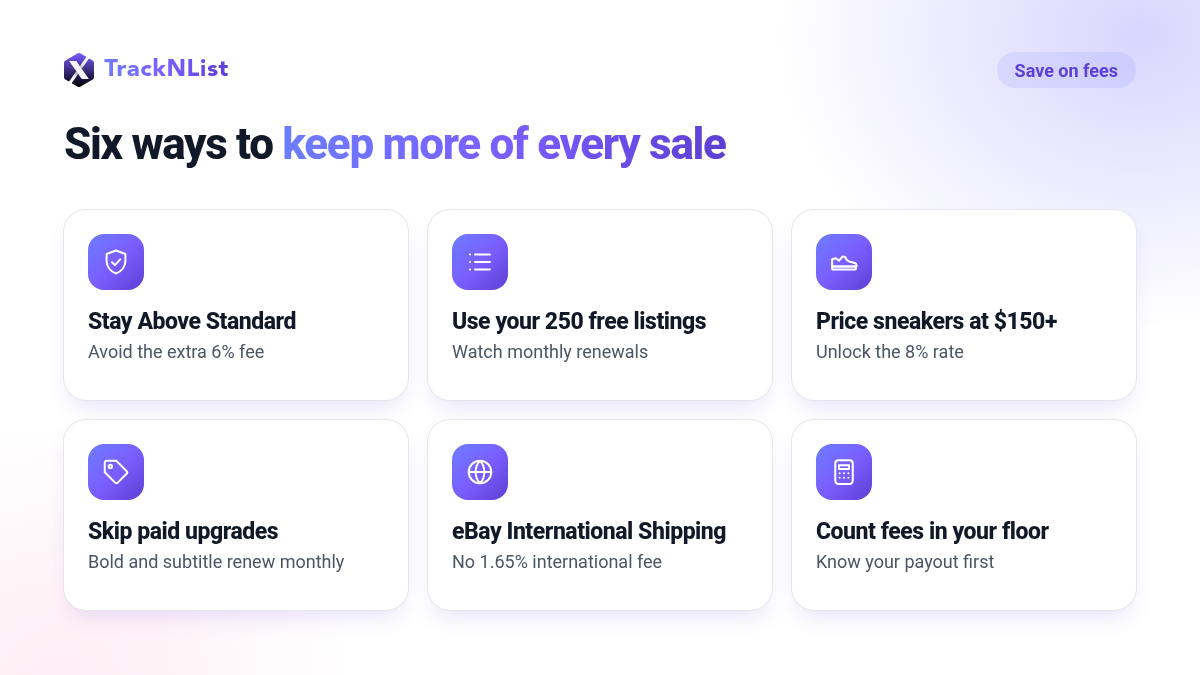
- Stay Above Standard. The extra 6% for Below Standard sellers costs far more than any upgrade. Ship on time and avoid cancellations.
- Use your free listings wisely. Know how many of your 250 monthly zero insertion fee listings you have left, especially with Good 'Til Cancelled listings renewing every month.
- Watch the $150 sneaker line. Price pairs near the threshold with the 8% rate in mind.
- Skip upgrades that do not pay for themselves. Bold and subtitles renew with every Good 'Til Cancelled cycle.
- Ship international orders with eBay International Shipping to avoid the 1.65% international fee.
- Build fees into your floor price. Know your minimum acceptable payout before you accept an offer. Our guide to pricing for maximum profit across marketplaces walks through setting floors platform by platform.
Track Your Real eBay Profit Automatically
Working out fees by hand for every sale gets old fast, especially when the same item is listed on eBay, Poshmark, Mercari and more, each with its own fee rules. TrackNList keeps your inventory in one place, crosslists to 10+ marketplaces, and delists everywhere else the moment an item sells, so you protect your eBay seller level while you sell in more places.
Start free and see your real profit on every eBay sale next to every other marketplace you sell on.


