
5 Signs You've Outgrown Spreadsheets for Your Reselling Business

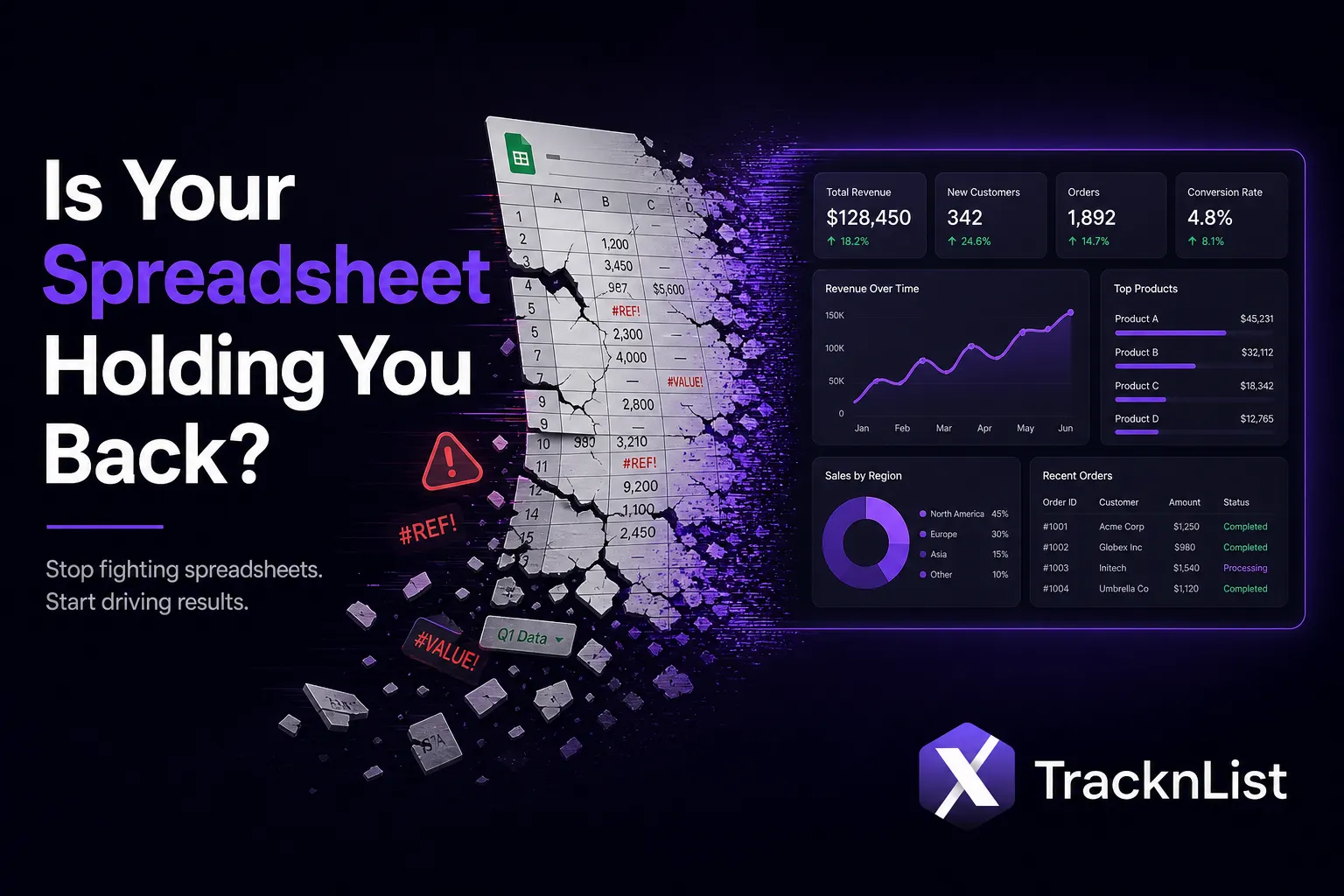
Every reseller starts the same way. A Google Sheet with some columns — item name, purchase price, platform, status, maybe a notes column. It works. For a while.
Spreadsheets are great when you're flipping 10-20 items a month. They're manageable at 50. But somewhere between 100 and 200 active listings across multiple platforms, the spreadsheet stops being a tool and starts being a liability.
The tricky part is that the transition from "this works fine" to "this is actively costing me money" happens gradually. Here are five signs you've already crossed that line.
1. You've Lost Track of What's Listed Where
You know you have that Supreme hoodie in your inventory. You're pretty sure it's on eBay. Maybe Grailed too? Is it still on Poshmark or did you take it down last week?
When your spreadsheet can't immediately tell you which platforms each item is live on — or worse, when the spreadsheet says one thing but reality says another — you have a tracking problem.
This happens because spreadsheets rely entirely on you to keep them updated. Every time you list an item on a new platform, you have to go back to the sheet and add it. Every time you delist, you have to update the status. And if you forget — or you're in a rush and skip it — the sheet falls out of sync with reality.
The result is ghost listings (items your spreadsheet says are live but aren't), invisible listings (items that are live but your spreadsheet doesn't reflect), and a general feeling of uncertainty about your own inventory.
At 50 items, you can scroll through and spot-check. At 200+ items across five platforms, that's not realistic.
2. You've Oversold an Item This Month
This is the clearest signal. If you've had to cancel an order because the item already sold on another platform, your inventory management system has failed.
Spreadsheets can't prevent overselling because they can't react in real time. When an item sells on Mercari at 2 AM, your spreadsheet doesn't know. It won't alert you. It definitely won't go delist that item from eBay, Poshmark, and Grailed automatically.
You're the middleware. And humans aren't built to be middleware — we sleep, we get busy, we forget.
One oversell is a mistake. Two is a pattern. If it's happening regularly, the problem isn't you — it's the tool. Spreadsheets were never designed to manage real-time multi-platform inventory.
3. Updating Your Inventory Takes Longer Than Sourcing
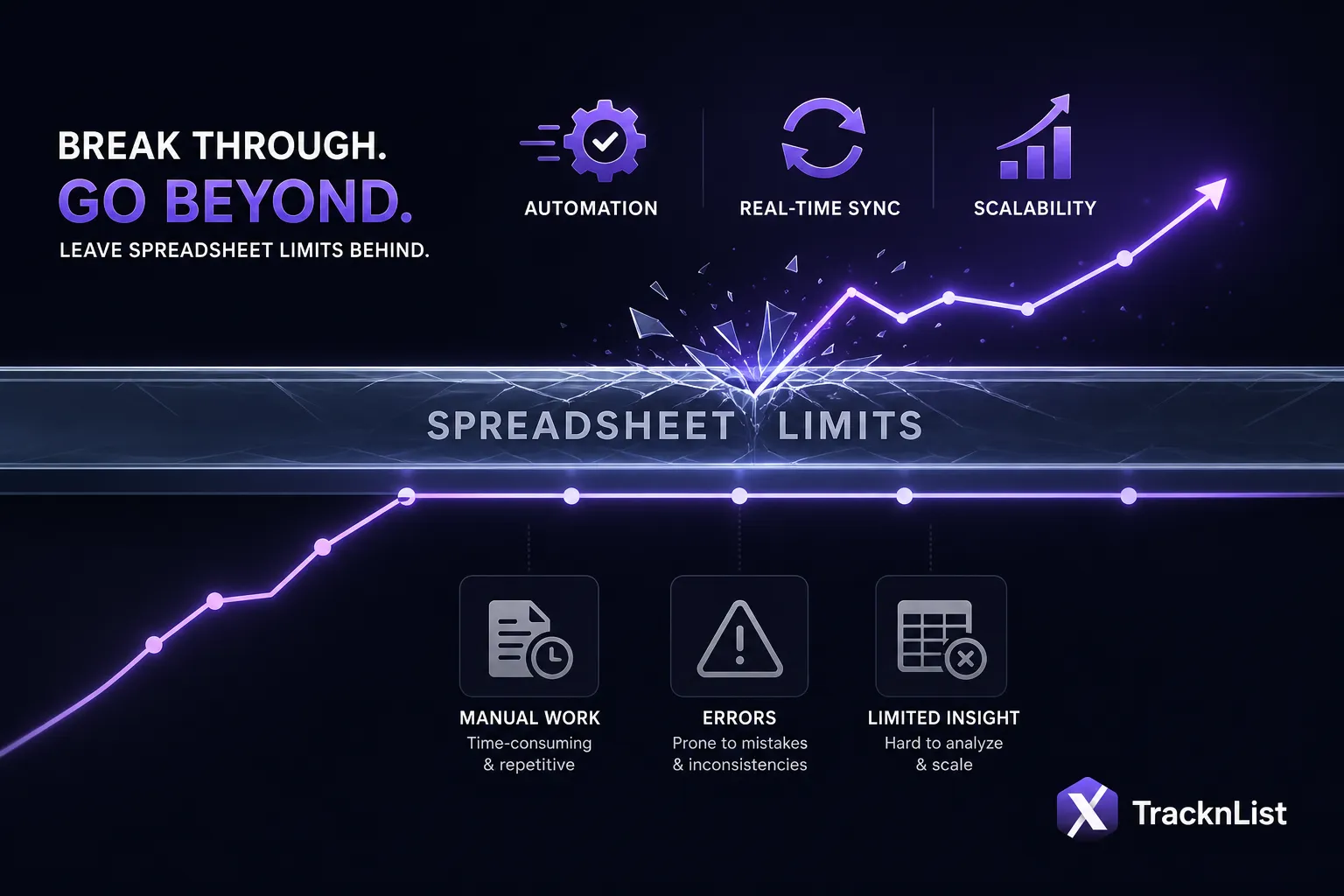
There's a moment in every reseller's journey where they realize they're spending more time on administrative work than on the activities that actually generate revenue.
Sourcing is revenue-generating. Negotiating deals is revenue-generating. Pricing strategy is revenue-generating. Manually updating a spreadsheet every time you list, delist, sell, or adjust a price is not.
If your weekly routine looks something like this, you've hit the spreadsheet ceiling:
- Monday: Source 15 items
- Tuesday-Wednesday: Photograph, list on 4 platforms, update spreadsheet for each
- Thursday: Check which items sold, update spreadsheet, delist sold items from other platforms, update spreadsheet again
- Friday: Realize spreadsheet is already wrong because you forgot to log two sales from Tuesday night
The administrative overhead grows linearly with your inventory. More items means more rows, more updates, more chances to miss something. At a certain point, the spreadsheet becomes the bottleneck — not your sourcing, not your pricing, not your market.
4. You Have 100+ Items and It's Getting Chaotic
There's no magic number where spreadsheets break, but 100 active listings is where most resellers start feeling the pain.
At this scale:
- Scrolling through the sheet to find a specific item takes too long
- Filters and sorting help, but maintaining them adds more work
- Formulas break or get accidentally overwritten
- The sheet loads slower, especially with images or complex formulas
- You start creating multiple tabs (by platform, by status, by category) which fragments your data
- Collaborating with a partner or assistant becomes a nightmare of version conflicts
Spreadsheets are flat. Your reselling business is not. You're dealing with relationships between items, platforms, sizes, prices, costs, and sales — a spreadsheet forces you to flatten all of that into rows and columns, and it shows.
The chaos isn't a personal failure. It's a tool limitation. You haven't gotten worse at organizing — your business has grown past what the tool can handle.
5. You Dread Listing on a New Marketplace
This is the most telling sign. When someone suggests you try Depop or list on Facebook Marketplace, and your first thought is "that sounds like so much work" — that's the spreadsheet talking.
Adding a new marketplace should feel like an opportunity. More buyers, more exposure, faster sell-through. But when you're managing everything manually, each new platform means:
- Another column (or tab) in your spreadsheet
- Re-entering every item's information in a different format
- Another place to check for sales
- Another platform to manually delist from when something sells elsewhere
- More complexity, more room for errors
So you don't add it. You stick with two or three platforms because that's all your system can handle. And you leave sales on the table because the operational cost of expanding feels too high.
This is the spreadsheet ceiling. It's the point where your tool is actively limiting your business growth — not because the demand isn't there, but because the back-end can't keep up.
What Comes After Spreadsheets
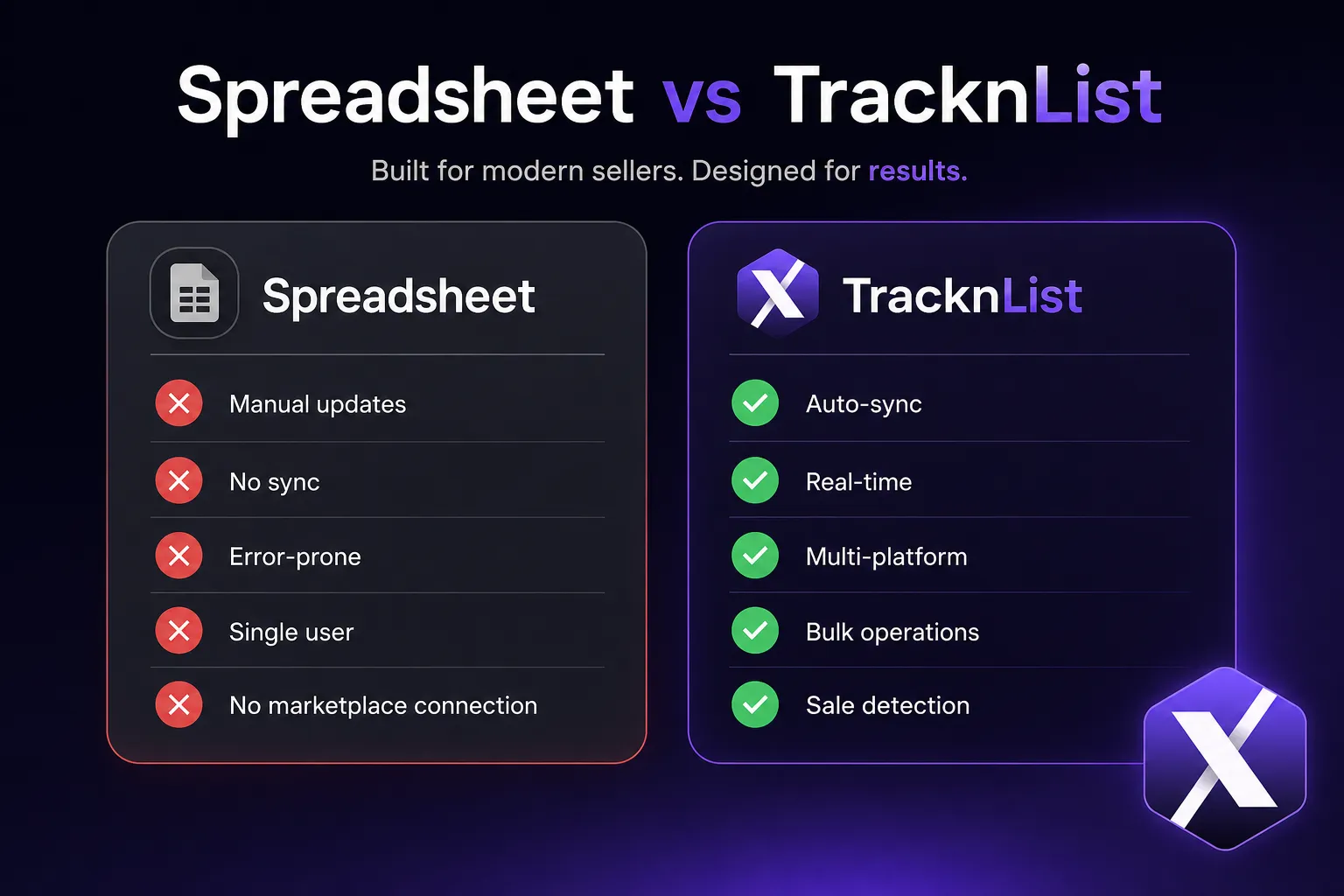
The jump from spreadsheets to dedicated inventory management software feels big, but it's simpler than most resellers expect.
Here's what changes:
Your inventory becomes the single source of truth. Instead of a spreadsheet that might be outdated, you have a system that reflects your actual inventory state in real time. Every sale, every listing, every delist is tracked automatically.
Cross-listing becomes one click, not six. Add a product once, push it to every marketplace. No re-entering information, no reformatting for different platforms.
Inventory syncs automatically. When something sells, it's delisted everywhere else without you doing anything. No more overselling. No more racing to your phone.
Bulk operations replace one-by-one. Need to adjust prices on 50 items? Update descriptions across platforms? Delist a batch of sold inventory? Bulk tools handle in minutes what would take hours in a spreadsheet.
You get your time back. The whole point is to spend less time on operations and more time on the parts of reselling that actually make money.
Making the Switch
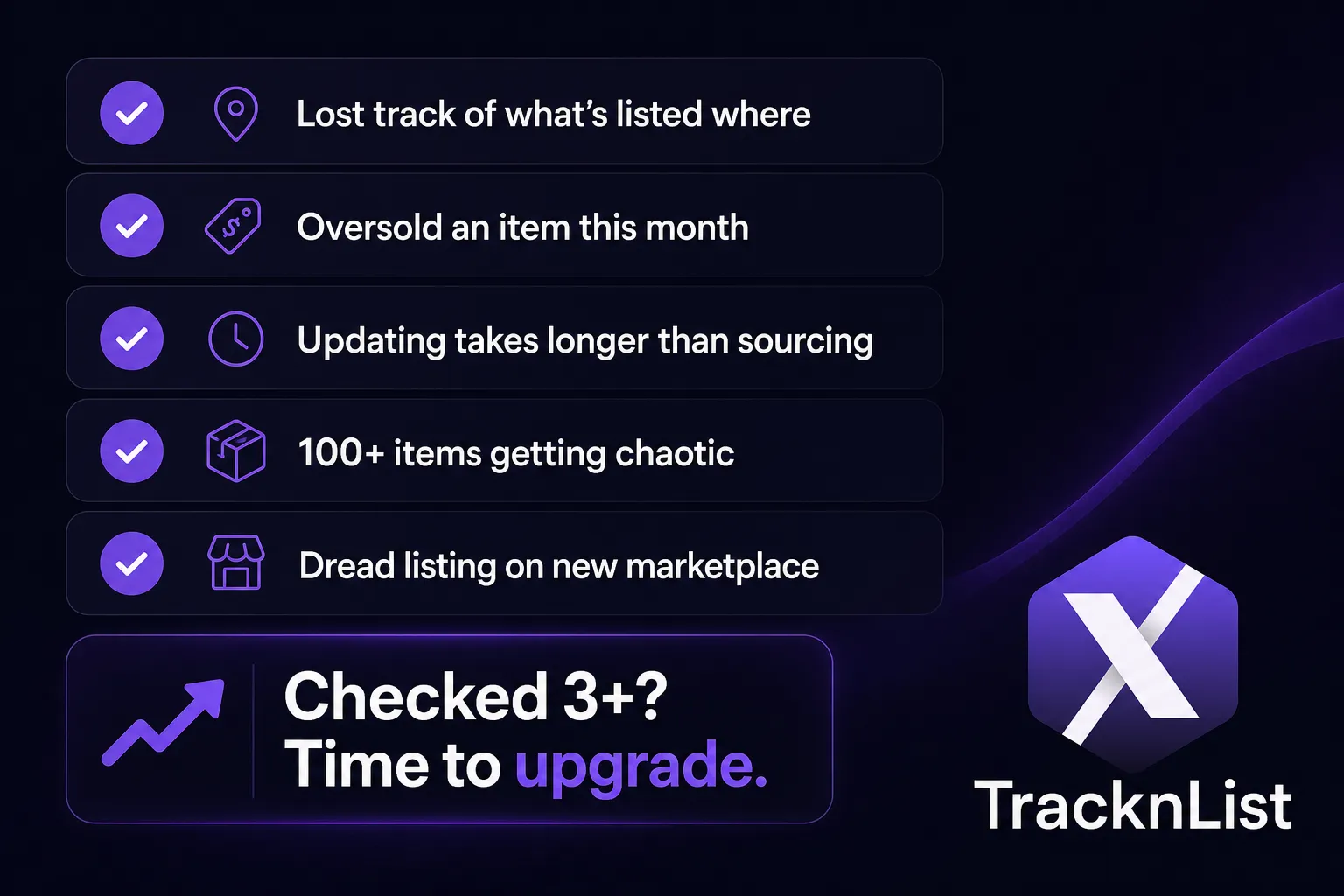
If you recognized yourself in three or more of these signs, you've already outgrown your spreadsheet. The longer you wait to switch, the more time and money you're losing to manual processes.
The good news is that most inventory management tools let you import your existing data, so you're not starting from scratch. Connect your marketplace accounts, import your inventory, and the system takes over the tracking and syncing you've been doing manually.
The resellers who scale past a few hundred items all have one thing in common: they stopped trying to run a growing business on a tool designed for grocery lists and homework assignments.
Your spreadsheet got you here. But it's not going to get you where you're going.
TrackNList replaces your spreadsheet with a real inventory management system — cross-list to 10+ marketplaces, sync in real time, and manage everything from one dashboard. Start your free 14-day trial →